Billing and collections
Connect delivered care to invoices and collection
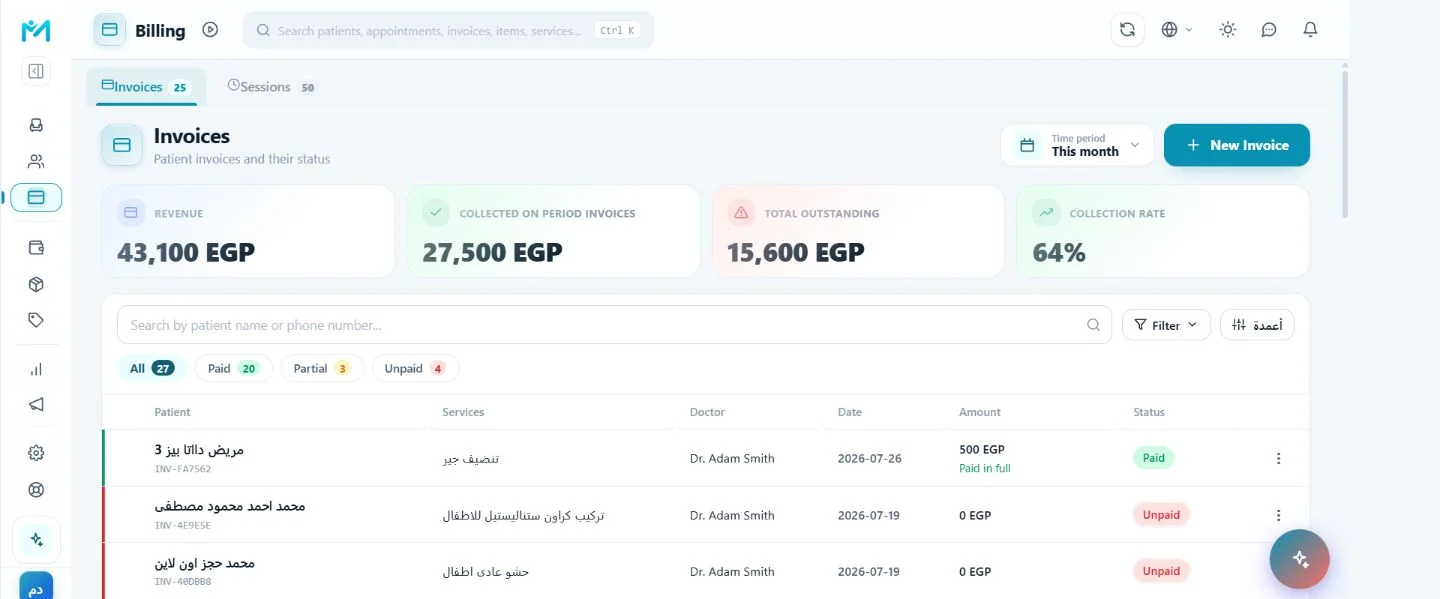
Billing and collections in Modirify connect the clinic service catalog, the patient visit, the invoice and each recorded payment. The result is not a detached sales total: it is a reviewable path from a delivered service to the remaining patient balance, with documented discounts, clear invoice states, receipts, daily collection and reports that show what still needs follow-up.
Direct answer
What does the billing and collections pillar manage?
It creates invoices from recorded clinic services, records payments and receipts, includes documented discounts in the invoice total, applies clear open, paid and written-off states under system rules, and follows daily collection and outstanding balances. Where the relationship exists, the invoice remains connected to the patient and visit rather than becoming an isolated accounting row.
01Billing and collections
These controls use the invoice and payment records as the operational source.
Core capabilities
The verified billing controls
These controls use the invoice and payment records as the operational source.
Record payments, issue receipts and follow remaining balances.
Documented discounts included in invoice totals.
Clear open, paid and written-off states under system rules.
Daily collection and outstanding-balance tracking.
Link invoices to patients and visits when the relationship is available.
Collections that lead to action
Move from one total to a follow-up list
Existing reporting and patient-balance guidance explain why the age and owner of a balance matter.
A total does not tell the team what to do
Knowing that patients owe a total amount says nothing about tomorrow’s action. The same figure can be healthy if most of it is recent and attached to continuing treatment, or close to lost if most is old. A decision needs a distribution rather than one total, while the patient and invoice links preserve the context behind that distribution.
Read balances by age
Split outstanding patient balances into age bands: under a month, one to three months, three to six, and over six. The distribution changes the response from a routine reminder to a call, a recorded payment plan or an explicit decision on an old case. Reports on invoices, collection and debt support that follow-up from recorded activity.
Start with the largest balances
Sort patients by amount owed and begin with the largest ten rather than sending a generic message to everyone. Following a defined group is work a staff member can complete; following every balance at once becomes a plan that never runs. The billing record supplies the amount, state and linked patient needed to make the list specific.
Use the next visit as useful context
When a balance is visible to authorized reception staff at booking or arrival, collection can become a routine part of the visit instead of an exceptional call. The patient record carries the financial summary and the billing workflow carries the invoice detail, so the team can follow the balance without keeping a separate notebook.
Record a plan instead of an open demand
A patient who cannot pay in full may postpone replying. A clear split with specific amounts and dates turns a hanging balance into expected instalments and gives the team something definite to follow. A collection policy also prevents new balances accumulating while older ones are being addressed.
Workflow
From recorded service to balance review
The invoice remains connected to the work and the patient wherever that relationship exists.
Create the invoice
Select delivered services from the clinic catalog and keep the invoice linked to the patient and visit when available.
Record adjustments and payment
Apply documented discounts, record each payment and issue the corresponding receipt.
Follow the current state
Use open, paid and written-off states and the remaining balance instead of a manually interpreted total.
Review collection work
Read daily collection, outstanding balances and available age or patient context to choose the next follow-up.
Daily value
Why the linked billing path matters
Numbers from invoices
Revenue, collection and outstanding values come from the recorded invoices and payments rather than a side spreadsheet.
Specific follow-up
A linked balance identifies the patient, the invoice state and the remaining amount.
Reviewable changes
Discounts, receipts and invoice states remain part of the recorded path.
Clear answers
Frequently asked questions
Where does the outstanding balance come from?
It comes from the recorded invoice total, documented adjustments and linked payments, not from a separate manually maintained figure.
Why review balance age instead of only the total?
A recent balance attached to continuing treatment needs a different action from the same amount left unresolved for many months.
Can a payment receipt be issued?
Yes. Recording payments and issuing receipts are verified billing capabilities.
Are invoices connected to the patient visit?
They are linked to patients and visits when that relationship is available, preserving the operational context for follow-up.
Start with Modirify
A cloud platform that helps dental clinics manage everyday work in one place.
Start with Modirify